Evidence Base
Scientific Advice from ICES
NASCO seeks to base its management measures on the best available scientific information.
The ICES Working Group on North Atlantic Salmon (WGNAS) is responsible for the annual assessment of the status of salmon stocks across the North Atlantic. NASCO asks WGNAS to provide catch advice, subsequently agreed by the Advisory Committee (ACOM), for both the Faroes and West Greenland fisheries.
WGNAS also develops advice on a wide range of other issues to support NASCO in exercising its responsibilities for the conservation, restoration, enhancement, and rational management of wild salmon in the North Atlantic.
- The latest WGNAS report can be found on the ICES website.
- The latest Report of the ICES Advisory Committee was published in May 2025, CNL(25)06.
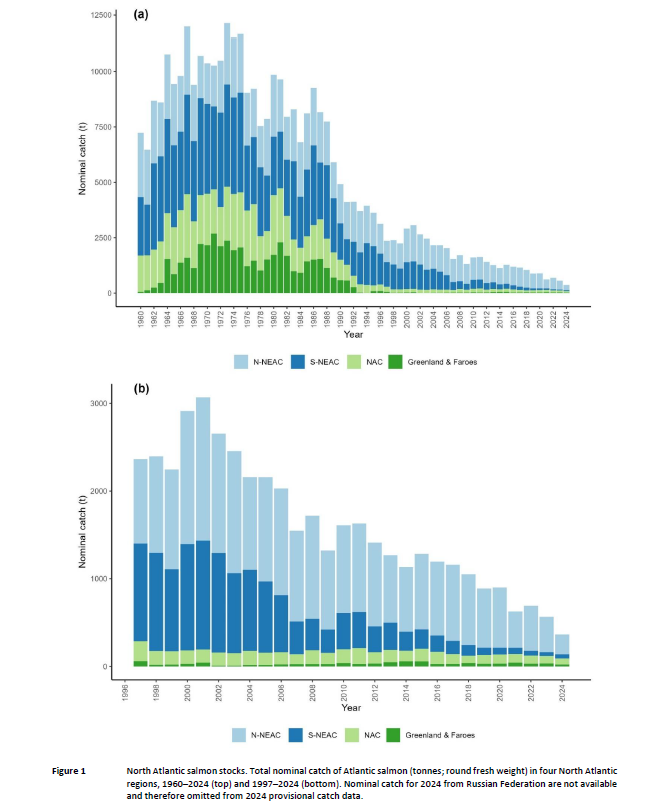
Source: CNL(25)06
The ‘Report of the ICES Advisory Committee’ from previous years, and NASCO’s annual ‘Request for Scientific Advice from ICES’ can be found on the Annual Meeting Pages.
Memorandum of Understanding
Advice is provided annually by the International Council for the Exploration of the Sea (ICES), under the Memorandum of Understanding between NASCO and ICES.
- Current NASCO – ICES Memorandum of Understanding (2022)
- Previous NASCO – ICES Memorandum of Understanding (2007)